For about seven years now, I've been the guy handling equipment orders for a mid-sized facility management company. I've personally made (and documented) a handful of significant mistakes, totaling roughly $12,000 in wasted budget. That's the kind of number that gets you a very uncomfortable conversation with the CFO. Now I maintain our team's pre-purchase checklist to make sure no one else repeats my errors. And the single biggest category of those errors? Assuming a lower purchase price means a lower total cost. Especially with floor scrubbers.
It's tempting to think you can just compare sticker prices. That's what most buyers focus on. But the question everyone asks is 'what's your best price?' The question they should be asking is 'what's my total cost per month of operation?' Ignoring that one question—the full scope—has cost me dearly, and I see other facility managers making the same mistake all the time.
The Surface Problem: Budget Blowouts on Floor Care
So, you're looking at replacing your aging floor scrubber. Budget is tight, as always. You see a machine from a less established brand—or maybe just a basic model—for significantly less than a Clarke or a Tennant. The temptation is real. I get it. In September 2022, I was in the exact same spot. We needed two new walk-behind scrubbers. I found a 'great deal' on a pair of machines—let's call them Brand X. The purchase price was 30% less than the comparable Clarke models.
On paper, it looked like a win. The specs were similar: same tank size, similar brush width, comparable scrub rates. I approved the order. That was my first mistake: I compared specs in a spreadsheet instead of actually thinking about the machine's total life.
The issue isn't the initial price tag. It's what happens after the machine arrives. If you've dealt with equipment purchasing for more than a year, you know that the upfront cost is only a fraction of the story. The real problem—the deep, hidden problem—is that most buyers are looking at the wrong metric entirely.
The Deeper Issue: The 'Oversimplification' Trap
There's a common misconception in our industry. People think a floor scrubber is a floor scrubber. It's a tank, some brushes, a squeegee, a motor. How different can they be? This is what I call the Oversimplification Trap. The 'it's all the same' advice ignores a ton of nuance, especially around serviceability and parts availability.
Most buyers focus on obvious factors like scrub width and battery life. They completely miss the critical factors of part availability, service network, and the machine's design for repairability. I learned this the hard way.
In December 2022, three months after we bought the 'budget' scrubbers, the first one broke down. A simple issue—the brush deck motor failed. If I remember correctly, it was a $200 part. But here's the kicker: that part was proprietary to Brand X. No local distributor stocked it. We had to order it directly from the manufacturer, and it took four weeks to arrive. (Should mention: that was after three phone calls and a service ticket that went unanswered for a week.) Four weeks of downtime for a machine we used daily. The cost of that downtime? Hard to quantify, but we had to pay overtime to our staff to manually scrub the floor for those weeks. Plus, the floor looked terrible for a month.
The Real Cost: Not Just Money, But Credibility
That's the problem with a lot of cheaper equipment. You're not buying a machine; you're buying into a repair ecosystem. If that ecosystem is weak, your total cost of ownership skyrockets. Let's run the numbers for those two machines over the 18 months we owned them:
- Initial purchase price (2 machines): $4,200 each = $8,400 total. (Saved about $3,600 vs. Clarke equivalents).
- Repair costs (parts + labor) over 18 months: $3,200 total. That includes the motor, a broken squeegee blade that was oddly expensive, and a battery pack issue. The parts were way more expensive than I expected.
- Downtime cost (lost labor & overtime): Approximately $1,800.
- Cost of frustration (my time dealing with issues): Priceless, but I value my time.
Net 'savings' evaporated. We spent $5,000 in repairs and downtime on machines we saved $3,600 on. We were in the hole by $1,400, plus we had to listen to the facilities team complain about unreliable equipment for a year and a half. In Q1 2024, we replaced them with Clarke units. They've been running for over a year with zero downtime. Not a single issue beyond routine maintenance.
Another time, I witnessed a classic communication failure on a big order. I said 'we need the heavy-duty model that can handle our warehouse.' The vendor heard 'we need the cheapest model that technically works indoors.' Result: we got a machine that couldn't handle the daily workload and broke down within three months. The spec sheet said 'industrial,' but the machine's build quality was clearly closer to commercial duty. We were using the same words but meaning different things. I discovered this when the machine literally stopped moving under a heavy load on day 90.
The most painful part wasn't just the repair costs—it was the loss of trust with my own team. When the machines kept failing, they started to question my purchasing decisions. That's a hard thing to rebuild.
The Checklist That Changed Everything
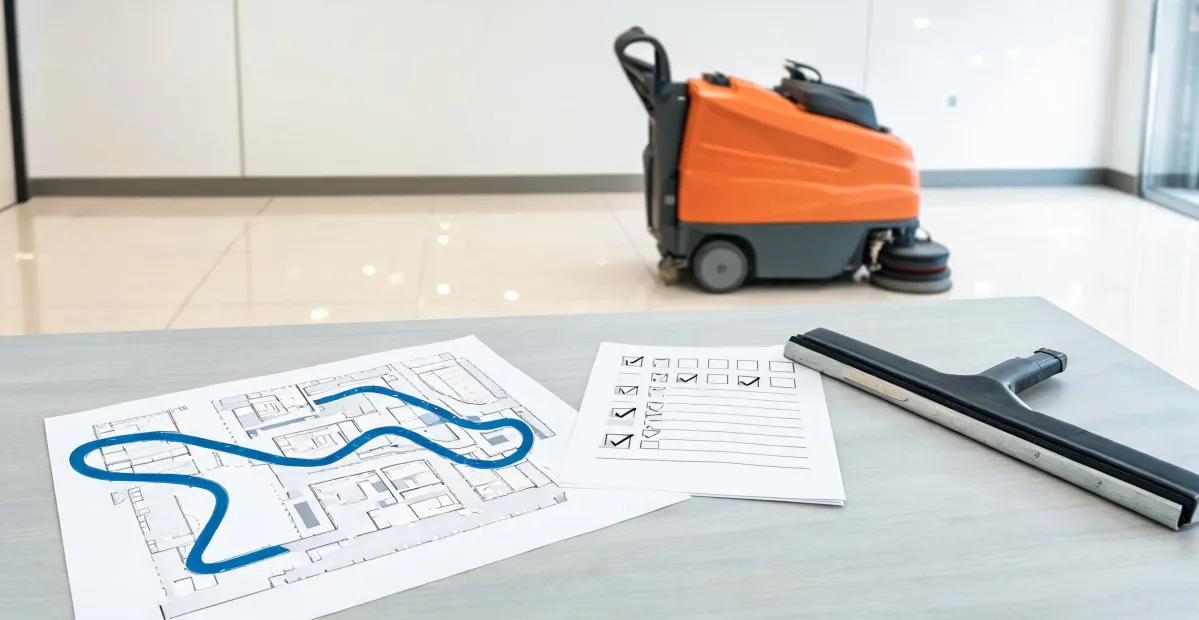
After the third rejection of a purchase request from my boss (basically, 'why are you buying this again?'), I created our team's pre-purchase checklist. It's not complicated, but it forces us to look at the whole picture, not just the price tag. The goal is to prevent the 'Oversimplification Trap.'
Here's the core of it:
- Quickly check parts availability. Can I get a new brush motor from a local dealer tomorrow? If the answer is 'we have to order it,' ask for the average lead time for 10 common parts. If the average is more than 5 business days, that's a red flag.
- Calculate TCO (Total Cost of Ownership) per month. Take the purchase price + estimated annual maintenance cost (10% of the purchase price is a good starting guess for cheaper machines, 5% for well-built ones) + estimated annual downtime cost. Divide by 12. That's your real monthly cost. We've caught 47 potential errors using this checklist in the past 18 months.
- Verify the service network. Don't take their word for it. Call three service centers within 50 miles of your facility. Ask them: 'Do you service Brand X? How long does it take to get parts?' If they say 'we only service the major brands,' that tells you all you need to know.
- Ask the operator question. Talk to the person who will actually drive the machine, not just the person buying it. They know what breaks and what's a pain to fix.
5 minutes of verification beats 5 days of correction. Seriously. These simple checks have saved us an estimated $8,000 in potential rework and downtime over the past two years. It's the cheapest insurance policy we've ever bought.
(I should add: the checklist also forces us to consider rental options. Sometimes you don't need to own a machine for a specific job. A short-term rental from a vendor like Clarke—they have a solid pre-owned and rental program—can be way cheaper than buying a 'budget' machine that will haunt you for years.)
The Bottom Line
My biggest lesson? The price tag is a trap. The 'budget' choice that looks smart on the purchase order can cost you dearly in repairs, downtime, and team frustration. A slightly higher upfront investment in a machine from a company with a solid service network—like Clarke, with their deep parts inventory and service support—is not an expense; it's an investment in reliability. It's prevention, not cure.
That saved $80 on shipping? It cost me $400. That 'smart' $3,600 savings on equipment? It cost me much more in the long run. Now, I spend my time checking parts lists and service networks, not just comparing sticker prices. (Prices as of early 2025; always verify current rates from multiple sources.)