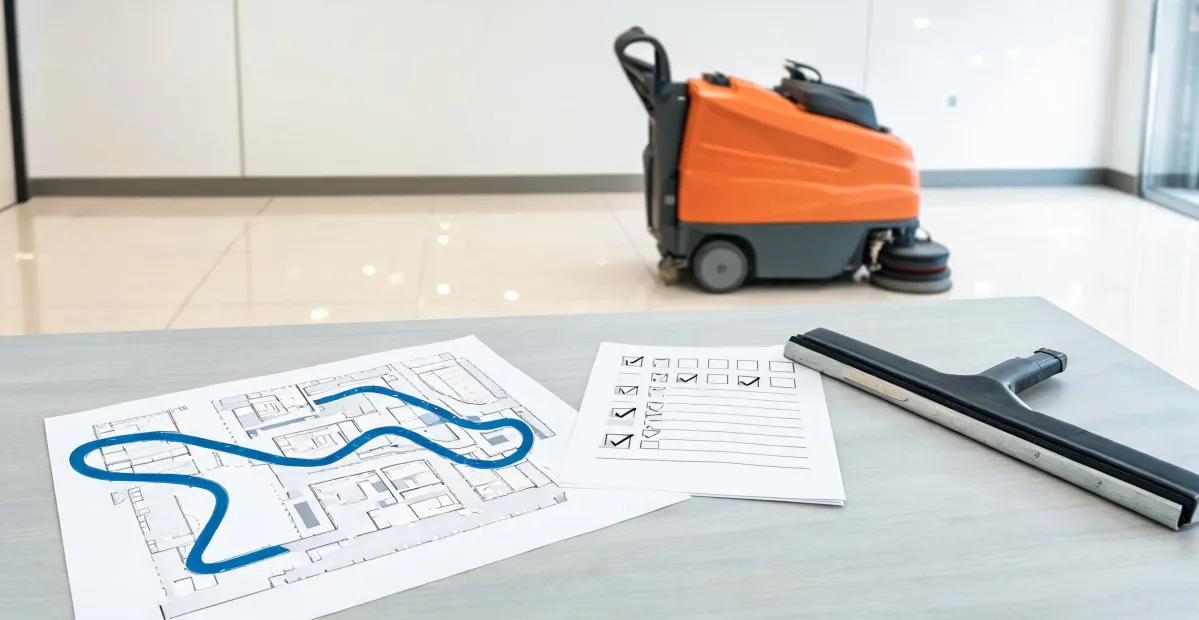
I've managed our facility equipment budget for about six years now—enough to know that a purchase order for a new scrubber is never just the invoice for the machine. When I first started, I'd get the quote for a Clarke floor scrubber, think "great, that's within budget," and move on. But the real cost picture didn't show up until we started factoring in the parts, the service, and the simple stuff—like whether you can actually get a replacement floor scrubber wheel quickly when one of yours cracks.
So when someone asks me about specifying equipment for a medium-sized facility—say, a 50,000 to 100,000 sq ft warehouse or distribution center—I don't jump straight to horsepower or brush pressure. I start with a different question: Are you buying a machine, or are you buying a support system?
This matters because the difference between a smart specification and a costly mistake often isn't in the base unit. It's in the ecosystem. If you're looking at the Clarke MA10 12E upright floor scrubber or trying to figure out the best path for sourcing Clarke floor scrubber parts for an existing fleet, here's a comparison I've been meaning to write down. It's not a review of one machine vs. another. It's a look at the decision you actually have to make: choosing between the total cost of ownership model and the "lowest initial quote" model.
What most people don't realize (and what made my first procurement mistake so expensive) is that the real financial risk isn't buying the wrong brand. It's buying an orphan.
The Real Comparison: Buying a New Clarke vs. Maintaining a Fleet
Here's a confession: I almost went with a cheaper alternative to a Clarke unit in my second year. The list price was about 15% lower, and the spec sheet looked comparable. But I made a classic rookie mistake: I didn't verify the aftermarket supply chain for Clarke floor scrubber parts or, more critically, for something as basic as floor scrubber wheels for comparable machines.
Let me break down the three dimensions I now use to compare any equipment option. The comparison isn't Clarke vs. Competitor X. It's Specifying New (with a parts ecosystem) vs. Sourcing Cheap (with unknown support). Every time I've made the wrong call, it was because I ignored one of these three things.
Dimension 1: Parts Availability & Compatibility (The "Will It Break Thursday" Factor)
When you're running a commercial operation, a down scrubber isn't an inconvenience—it's a cost leak. If a scrubber goes down on a Wednesday and you can't get a part until Monday, you've lost three days of productivity. For a facility our size, that's roughly $800 in wasted labor. Do that twice a year, and you've basically lost the savings from choosing a cheaper unit.
Here's where the Clarke MA10 12E upright floor scrubber ecosystem shines, and I say this as someone who doesn't work for Clarke. The parts network is mature. I've sourced floor scrubber wheels from three different distributors in the Midwest just by making a few calls. The same applies to belts, squeegees, and the vacuum motors. The aftermarket doesn't treat Clarke parts as a specialty item—they're a volume item. That means faster shipping and often better pricing. When I needed a specific RPS floor scrubber part last year (a controller board for an older unit we were debating whether to keep), the turnaround was three days. For a comparable cheaper brand I'd spec'd the year before, the same part was backordered for six weeks. Six weeks. The machine was essentially a $7,000 paperweight.
What most people don't realize is that the availability of common parts like floor scrubber wheels isn't just a convenience—it's a core cost driver. I built a simple cost calculator after getting burned on this: if a part is cheaper but takes 50% longer to get, the downtime cost can make the "cheap" part actually 40% more expensive on a total-cost basis.
Dimension 2: Applicability & The "One-Size-Fits-All" Trap
Here's something vendors won't tell you: a floor scrubber is not a floor scrubber. The Clarke MA10 12E upright floor scrubber is a specific tool for a specific job. It's an auto-scrubber with a 12-inch cleaning path, designed for tight spaces and smaller retail or institutional areas. It's not designed for a 200,000-square-foot industrial warehouse with heavy grease and metal shavings. For that, you'd be looking at an industrial ride on floor scrubber in a completely different weight class.
I assumed, when I first started, that "commercial floor scrubber" was a single category. It's not. The mistake I made was trying to use a small upright machine for a large open warehouse. It worked, but inefficiently. The machine wore faster, the floor scrubber wheels wore unevenly, and we ended up spending more on maintenance than we saved on the initial purchase price. It was a mismatch of scale.
If you're in a facility like mine—maybe a 50,000-square-foot distribution hub with a mix of tile and concrete—the Clarke MA10 12E is a pretty good fit for the tile sections. But for the concrete? That's where you start looking at a rider machine, and if you're asking about an industrial ride on floor scrubber Beloit (or wherever your distributor is), the conversation shifts from parts compatibility to machine capability. The honest limitation here is that one machine can't do it all, and anyone who tells you otherwise is selling you a compromise.
Dimension 3: Long-Term Support & The "What If We Keep It Five Years?" Scenario
This is the dimension where the budget controller in me gets most anxious. The first-year cost of a machine is often decoupled from the five-year cost. When I audit our annual spending, I look at the cumulative cost of parts and labor for each major asset.
I tracked Clarke floor scrubber parts spending over a 3-year period for our two main units. The total was predictable. It was within the range I'd estimated. For a competitor's unit we had (a cheaper brand I won't name), the parts spending was actually lower in Year 1. But in Year 2 and 3, it spiked. The failure rate on basic consumables like floor scrubber wheels was higher. The pads wore faster. The brush deck required a replacement due to a design flaw that wasn't apparent in the first year.
After comparing costs across 4 vendors over about 18 months for a new spec, I landed on a simple rule: if the parts ecosystem isn't robust enough to get me a replacement wheel or a squeegee blade within 48 hours, the machine doesn't qualify, regardless of the list price. The savings on the initial purchase get eaten up by the second or third downtime event.
Calculated the worst case for a budget machine: total failure at 18 months, with a replacement cost plus lost productivity of about $14,000. Best case: it limps along for four years, but with $600 more in annual parts than a more established brand. The expected value said go with the known ecosystem. The downside of being wrong on the cheap option felt too catastrophic for our current budget cycle.
So, What's the Play? When to Spec Clarke and When to Look Elsewhere
Okay, I've been pretty pro-Clarke in this breakdown, but let me be honest about the limitations, because that's the only way this advice is useful.
I recommend the Clarke ecosystem (specifically something like the MA10 12E for smaller spaces, and their rider units for larger industrial floors) if:
- You need reliable, fast parts support. If Clarke floor scrubber parts aren't available within a reasonable time from your local distributor, that's a dealbreaker, but I've rarely found that to be the problem.
- You're managing a fleet of mixed equipment and want a consistent parts vendor. The breadth of the Clarke industrial ride on floor scrubber lineup means you can often source parts for multiple machines from the same distributor.
- You value predictable cost structures. The aftermarket for floor scrubber wheels and other high-wear items for Clarke units is competitive, which helps keep pricing stable.
I would say consider alternatives if:
- Your facility is highly specialized—maybe you need a scrubber for a very specific chemical environment or a uniquely shaped floor plan. Sometimes a niche machine from a specialist manufacturer is a better fit, even if the parts support is weaker.
- You have a strict capital budget that can't accommodate the slightly higher list price of a well-established brand, and you are prepared to self-insure against the downtime risk. (Note: I've tried this. The math didn't work for us.)
- You're looking for a used industrial ride on floor scrubber and the specific model you found is an orphan—no parts support. In that case, the machine's price is almost irrelevant because its value is capped by the availability of parts.
This solution—specifying equipment with a strong parts ecosystem—works for 80% of the cases I've dealt with. Here's how to know if you're in the other 20%: if your uptime requirement is so critical that a 24-hour downtime is a crisis, then you need a service contract, not just a parts network. That's a different procurement conversation entirely.
Procurement Lesson #47: I once approved a rush order for a replacement set of floor scrubber wheels at 4 PM on a Friday. The machine was down, the client had a Monday morning inspection. The rush fee was $150. The alternative—cancelling the inspection—would have cost us a $12,000 contract. The $150 was the best investment of the quarter. Never assume standard turnaround is acceptable if you don't know the cost of failure.
For me, the lesson has been consistent: the decision to spec a new machine isn't a one-time purchase. It's a vote on what kind of maintenance lifecycle you're signing up for. If you ask me, the smart money isn't on the lowest quote. It's on the machine with the most proven parts path. That's why I keep coming back to the Clarke ecosystem when I'm planning our equipment renewals. The prices aren't the cheapest. But the total cost?
In our procurement system, over the life of the asset, the cheaper options never stayed cheaper. The Clarke units did. That's the math that matters.