-
'Best' Is A Dangerous Word
-
Pad Size Is An Expense, Not A Spec
-
What 'Floor Scrubber Spin' Actually Tells You
-
Budget Brands Are Not The Enemy
-
The Support Network Is The Real Machine
-
If You're Planning A Facility, Plan The Floor Care Early
-
A Note For The 'Clarke Welder 130EN' Searchers
-
The Counterargument And My Final Position
Most floor scrubber buying mistakes happen before the machine ever touches the floor. They happen when someone falls in love with a spec sheet and forgets to ask the boring questions: What pads does it take? How fast does the pad actually spin? What happens when it breaks?
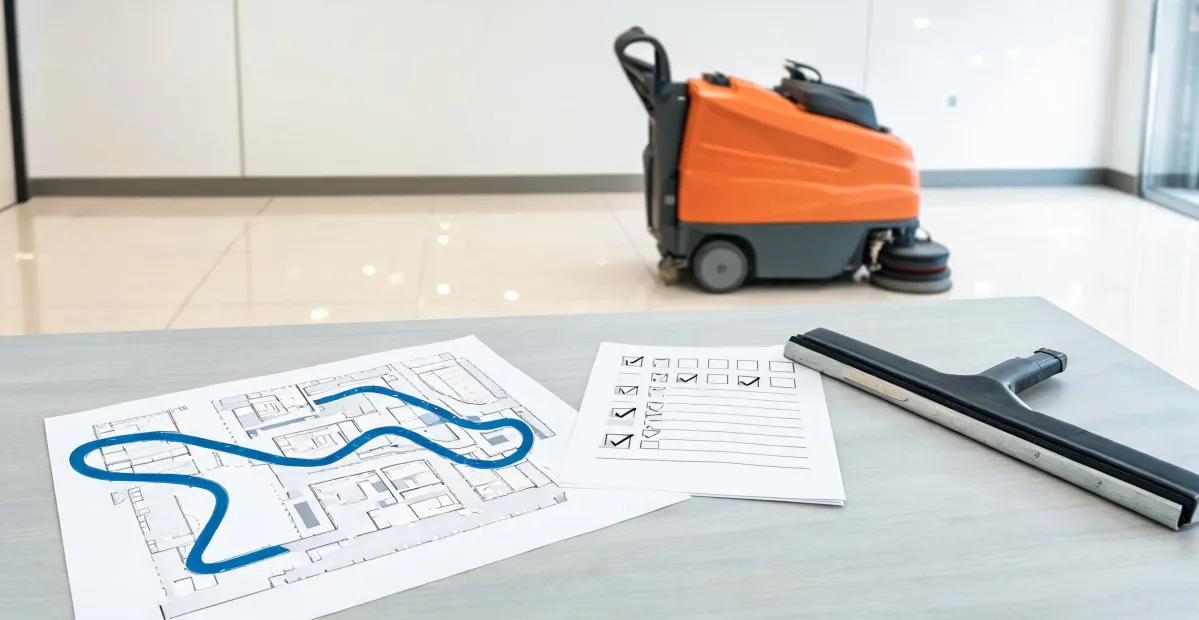
I'm a parts and service coordinator for a commercial equipment dealer. I've been handling orders for 7 years, and I've personally made (and documented) 9 significant mistakes totaling roughly $14,300 in wasted budget. That does not include the mistakes customers made that I was too embarrassed to ask about. Somewhere along the way I became the person who keeps the checklist. That checklist has caught 23 potential errors in the last 18 months. I'd rather share it than use it on you.
'Best' Is A Dangerous Word
The most common email I get goes like this: 'What is the best floor scrubber?' I used to ask the same thing. But 'best' is the wrong lens for this category. A Clarke floor scrubber can be the right tool for a 50,000 sq ft warehouse and a terrible tool for a small doctor's office. A Vevor floor scrubber can be perfect for a workshop and laughable for a loading dock. 'Best' only makes sense when you add 'for what?'
Pad Size Is An Expense, Not A Spec
The first mistake I ever documented was on a pad order. In 2021, I submitted a quote for a floor scrubber that used 13 inch floor scrubber pads. The customer said their machine was a 13-inch model. I checked the photo, approved the order, and we shipped 40 pads. Every pad had the wrong center-hole mount. It looked fine on my screen. The result was $240 in useless pads, a $310 restocking fee, and a 5-day delay for the customer. That's when I learned to measure a pad, not just look at the model number.
13 inch floor scrubber pads sound interchangeable. They're not. Some have center holes, some have loop backing, some are thick and designed for stripping, some are soft for buffing. The difference matters because pad cost is a recurring cost. If you buy a machine that takes a less common size, you're tied to that size for the life of the machine.
What 'Floor Scrubber Spin' Actually Tells You
Another search phrase that makes me cringe is 'floor scrubber spin.' It's kind of useless without context. A machine can spin at 1,500 RPM and do little more than polish a shiny surface. Another can spin slowly and still scrub heavy grime because of down pressure and pad type. If you're comparing models, ask for pad speed in RPM and pad pressure. And ask whether the machine can handle your floor finish. In September 2022, I recommended a multi-purpose scrubber for polished concrete without checking down pressure. The result was swirl marks in an expensive showroom. Fixing it cost $650 in grinding and recoating. The word 'multi-purpose' on the box did not mean 'safe on every finish.'
Budget Brands Are Not The Enemy
I do not like watching buyers choose a premium brand when a cheaper machine would do the job. I also hate seeing them buy a cheap machine for a job it was never meant to do. A Vevor floor scrubber is an entry-level tool. For 1,000-square-foot jobs, it can be fine. For continuous shifts, it's not in the same product category as a Clarke floor scrubber. That's not a comment on their engineers; it's a comment on duty cycle. I once told a client that a budget machine would save them $2,300. I hit send and immediately thought, 'I should have asked about the runtime.' It failed after 4 hours of continuous use. The next week they bought the more expensive machine. My advice saved $2,300 on the invoice and cost them $3,800 in downtime and labor. I was wrong.
The Support Network Is The Real Machine
In my job, I see the machine after the sale. That changes your perspective. The most expensive scrubber is not the one with the highest price tag; it's the one that sits in the corner waiting for a part. When a customer asks me to recommend a Clarke floor scrubber, I'm thinking about the part catalog, the availability of consumables, and whether someone can fix it in under a week.
Granted, a Clarke floor scrubber costs more upfront. But when you divide the total cost by the hours it actually runs, the gap shrinks. I don't have hard data on industry-wide total cost of ownership. What I can say anecdotally is that in 7 years of orders, the machines with local parts support cost less to keep running than the ones with a 3-week wait for a pump. Honestly, I'm not sure why some brands sell machines without a clear parts plan. My best guess is they assume you'll buy a new one.
If You're Planning A Facility, Plan The Floor Care Early
Here's an angle that surprises people. If you're searching for 'land for sale Clarke County MS' because a warehouse is in the future, floor care should be part of that conversation. I talked to a facilities manager last month who moved into a new building on a parcel of land that was advertised as 'land for sale Clarke County MS.' The building was great. The floor scrubber was not. He bought a small 13-inch walk-behind because it fit the budget, but the square footage required a ride-on. Now he either runs the machine for 6 hours a day or hires someone else to finish the job.
That decision cost him more in labor than he saved on the machine. Match the machine to the square footage, not to the deal.
A Note For The 'Clarke Welder 130EN' Searchers
I know some of you are here because you searched 'Clarke' and meant a different product. The Clarke welder 130EN, for example, is a welding machine, not a floor scrubber. The brand name is the same, but the lesson is the same. Buy the tool that matches the duty cycle and has consumables available. A welder that is too small for the job will burn out just like a scrubber that's too small for the floor.
The Counterargument And My Final Position
To be fair, there are plenty of situations where a mop, a cheap scrubber, or a rental makes more sense. I get it. Budgets are real. I have recommended budget machines, and I'll keep doing it when the math works.
But if you run a commercial facility with safety standards, compliance audits, and a schedule that cannot afford downtime, the machine is not a commodity. It's a tool that either works or costs you money in ways you cannot invoice. OSHA's walking-working surfaces rule (29 CFR 1910.22) says walking surfaces must be maintained clean and dry. That makes floor care a compliance issue, not just a housekeeping preference.
When I say 'Clarke' around the shop, I mean the equipment line and the support network that keeps it running. When I say 'Vevor,' I mean a good option for light duty. Neither statement is a sales pitch. It's context. An informed customer asks better questions and makes faster decisions. That's the kind of customer you want to be. Start with the check questions: What size pads does it take? How fast does the floor scrubber spin under load? Where do you buy parts? If you start there, you'll probably avoid the mistakes that built my checklist.