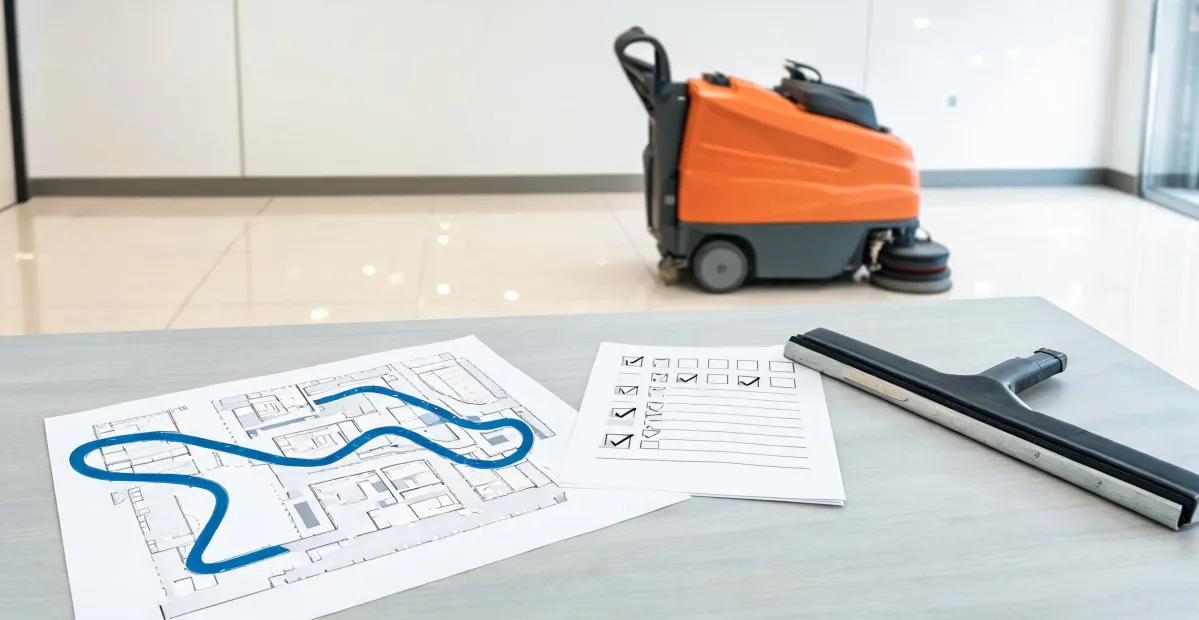
The short version: a reconditioned Clarke auto scrubber can deliver about 80% of the performance at roughly half the price of a new unit—but only if you verify three things first: battery health, service documentation, and parts availability. Skip those, and your savings can evaporate faster than a squeegee blade wears down.
I manage purchasing for a multi-site facilities operation—roughly $420,000 a year across a dozen vendors. Floor scrubbers land on my desk because no one else wanted the line item. Five years of buying, maintaining, and occasionally apologizing for these machines has taught me what actually matters on paper versus what matters on the warehouse floor.
And here's the surprise: the reconditioned market in 2025 isn't the same market I started working with in 2020. The fundamentals haven't changed, but the execution has. In the old days, "reconditioned" could mean a fresh coat of paint over a worn-out machine. Today, reputable dealers document battery tests, replace wear items, and offer warranties. That's a big shift.
Why I changed my mind about reconditioned floor scrubbers
I didn't trust reconditioned equipment for years. It felt like buying a stranger's used car—except the stranger's miles were recorded in hours of grinding, wet, gritty work. I only changed my mind after making a mistake that cost us $1,800.
In March 2024, we bought a "certified reconditioned" Clarke auto scrubber from a vendor we'd never used. Price was 55% below a new equivalent—first red flag, I should've known better. The machine arrived cosmetically perfect. Fresh paint, new brushes, clean squeegee. The problem was the battery pack: original, installed back in 2018. Nobody disclosed that, and I didn't ask. Within three weeks, runtime dropped from three hours to ninety minutes. Replacement batteries plus labor ate the entire price advantage.
I'd been warned for years to check the battery test report before signing. I skipped it because the hour meter looked reasonable. The hour meter doesn't tell you anything about a battery. To be honest, that mistake kinda changed how I evaluate every equipment purchase now.
I'm not a mechanic, so I can't give you a technical teardown of brush deck alignment or squeegee tension. What I can tell you from a purchasing perspective is how to verify a vendor's claims without needing a voltmeter. It's simpler than you'd think.
The checklist I use before buying a reconditioned Clarke
After eight floor equipment purchases—four new, four reconditioned—I've settled on a list of questions. They apply to any brand, but they fit Clarke's lineup especially well because Clarke publishes service records and carries parts honestly.
- Battery health (the big one). Ask for a load test report with a date on it. Every reputable reconditioning shop has one. If they hesitate, walk away. If you're looking at lithium options—several Clarke auto scrubber models offer them now—ask for charge cycle history instead. Lead-acid degrades with age; lithium degrades with cycles. Either way, the battery is the most expensive single part of the machine, mechanically speaking (i.e., it can be 20-30% of a used unit's value).
- Service documentation. A reconditioned machine should arrive with paperwork showing what was replaced, what was measured, and what was merely inspected. When a vendor tells you "we don't keep that stuff," what they're really saying is they don't know what the machine has been through. Don't take that risk.
- Parts availability. This is Clarke's quiet advantage. They still supply parts for scrubber models from a decade ago, which is why a used Clarke makes more sense than a used no-name machine that needs a squeegee shipped from overseas.
- Warranty in writing. Insist on at least 90 days for a reconditioned unit. Our current machine came with 12 months on the battery and six months on everything else. If a vendor won't put terms on paper, that answer alone tells you what to do.
The pricing math as of early 2025: a reconditioned Clarke auto scrubber runs anywhere from $4,500 to $12,000 depending on the model and what the vendor replaced. A comparable new unit lands between $9,000 and $25,000. Those figures come from dealer quotes and resale listings we've tracked over the past two years, so verify current rates—this market moves quicker than it used to.
One more thing: compare total cost of ownership, not sticker price. A $6,000 reconditioned machine that needs $1,800 in batteries and $400 in squeegee replacements within 60 days is more expensive than a $10,000 new unit with a warranty covering all of that. We track repair costs per machine per year at our company. It's the only honest way to compare.
What the search data tells us (and two detours)
Every few weeks, someone lands on a Clarke page expecting something else. Part of that is the name. Part of it is the industry changing faster than public perception.
People search for "EGO floor scrubber" constantly. EGO—the battery-powered equipment brand known for lawn mowers and leaf blowers—doesn't make a commercial floor scrubber (as of early 2025, at least). But I understand why people look. That search reflects a real expectation: a scrubber that runs cordless, lasts a full shift, and doesn't have a cable snaking across the building. The floor machine industry has woken up to that expectation. Clarke's battery-powered auto scrubbers have improved noticeably in the past three years, partly because consumer battery tools reset everyone's standards for runtime and reliability.
The other detour: "Clarke County VA homes for sale." Wrong Clarke entirely. This one scrubs floors; the Virginia county sells real estate. Search engines mix them up more often than you'd think. If you got here that way, you're in the right place for equipment advice—just not acreage.
And if you're searching "warehouse floor sweeper Germantown"—or any variation on that—the same rules apply. Whether it's a Clarke auto scrubber in a distribution center or a heavy-duty sweeper in a Germantown warehouse, the due diligence is identical: battery, documentation, parts. Geography doesn't change the math.
When a reconditioned machine doesn't make sense
I have mixed feelings about reconditioned equipment. On one hand, it's where the value is. On the other hand, it's not right for every operation. If you're hoping for a one-sided endorsement, here's the other side.
If your operation runs a scrubber ten hours a day, seven days a week, buy new. Uptime, full warranty, and a predictable maintenance schedule are worth the premium. The reconditioned savings shrink fast when the machine is down and your facility is losing labor hours.
If you work in pharmaceutical, medical, or food-processing facilities where clients require strict compliance documentation, a reconditioned machine can be a headache. Some certifications require manufacturer-stamped maintenance history, and a third-party reconditioning shop may not be able to provide that.
And if you're not willing to verify the battery before you sign, buy new—because the price difference disappears the moment you replace a pack six weeks in.
The limits of my advice
I'm an administrator, not an engineer. The checklist above keeps bad vendors out, but it won't tell you whether a belt is about to snap or a bearing is ready to fail. If you have a maintenance lead or a facility engineer on staff, have them spend ten minutes reviewing the service history before you commit. I started doing that on every order, and it has caught things I would never have seen on paper.
The industry has changed, and reconditioned equipment is the clearest example of that. Better battery chemistry, better testing standards, better parts support. The fundamentals never shifted—verify, don't assume—but the execution is genuinely better than it was in 2020. That's why I'll keep buying reconditioned Clarke machines. I'll just keep asking the hard questions first.