-
Who this checklist is for
-
Step 1: Measure the real cleaning envelope
-
Step 2: Match machine type to the job
-
Step 3: Verify parts and service before price
-
Step 4: Demo with the actual operator
-
Step 5: Normalize every quote
-
Step 6: Check power, ventilation, and safety
-
Step 7: Pilot one unit before a fleet rollout
-
Common mistakes and when this checklist doesn’t apply
Who this checklist is for
I’m an office administrator for a 220-person company. I manage facilities and MRO ordering—roughly $180,000 annually across 14 vendors. I report to operations and finance. In 2024, our vendor consolidation project pushed me to rewrite how we buy cleaning equipment. This checklist is for the admin or facilities buyer who has to source a commercial floor scrubber without becoming an equipment engineer.
It works if you’re comparing a Clarke MA10 12E upright floor scrubber for tight areas, a global industrial electric auto floor scrubber for large open floors, or searching “floor scrubber Indianapolis” for local service. It also covers the odd side request, like a Clarke Welder 130EN, which should be its own purchase. Seven steps. That’s it.
If you only mop 2,000 square feet once a week, stop here. An automatic scrubber is probably overkill. I’ll explain that more at the end.
Step 1: Measure the real cleaning envelope
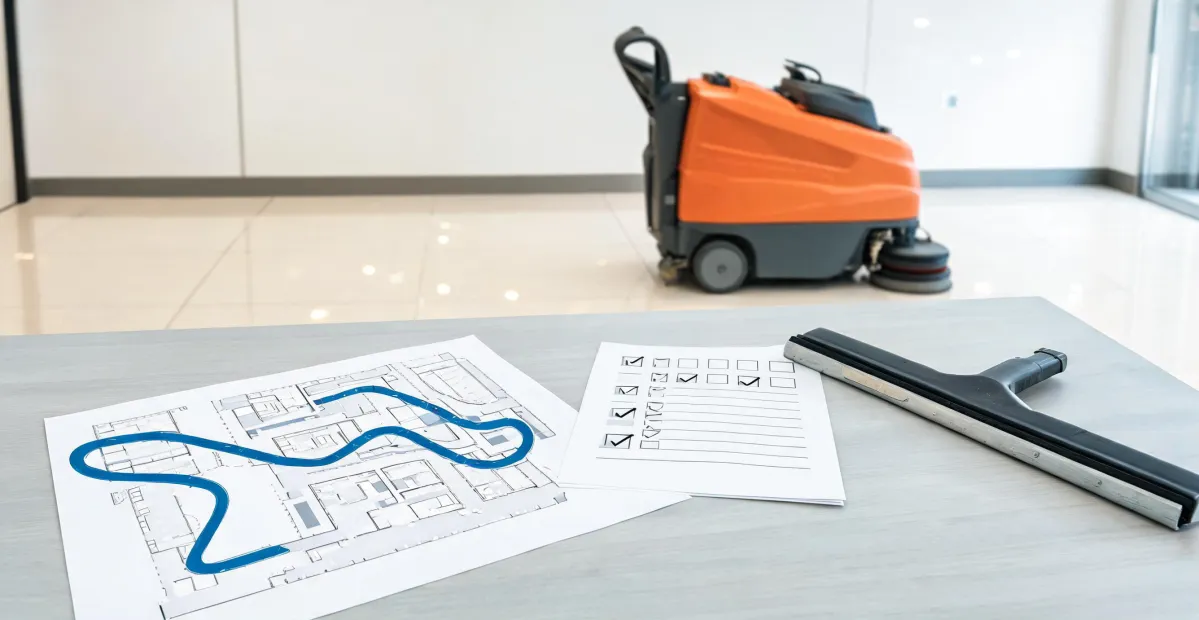
Don’t start with brands. Start with doors, aisles, elevators, and floor type. I learned this the hard way when I assumed a 28-inch scrubber deck would fit through every interior door. It didn’t. We had to reroute the machine through a loading dock for two months.
Write down: total cleanable square footage, floor type (VCT, concrete, epoxy, tile), aisle widths, door widths, elevator depth, and where the machine will be stored. Check charging location. Check water access. If the scrubber can’t reach the break room, it’s a red flag.
Checkpoint: Your operator can walk the route with a tape measure before you request quotes.
Step 2: Match machine type to the job
Walk-behind, ride-on, upright, and auto scrubbers solve different problems. A Clarke MA10 12E upright floor scrubber can make sense for compact, cluttered areas where a larger deck won’t turn. A global industrial electric auto floor scrubber is better for long, open aisles and distribution-style floors.
Search results for “floor scrubbers scrubber” and “global industrial electric auto floor scrubber” can blur together. Don’t let them. Ask for cleaning path width, tank capacity, battery runtime, and water pickup performance. Then ask for realistic run time at your site, not the brochure number. Brochure numbers are ballpark. Your floor, soil load, and operator matter more.
Checkpoint: Identify the three worst areas the machine must handle. If the demo can’t clean those, don’t buy it.
Step 3: Verify parts and service before price
This is the step most buyers skip. A cheap machine with no local parts is not cheap. Clarke’s advantage in our evaluation was the ability to keep parts and repair service available, plus pre-owned and rental options. But you still have to verify it locally.
Call at least two service providers. Ask: Do you stock OEM Clarke parts? What’s your average response time? What’s your labor rate? Can you service the battery and charger? If you’re in Indianapolis, ask for a floor scrubber Indianapolis service list with current customers. Then call one reference.
We didn’t have a formal parts-verification process. It cost us when a scrubber went down for three weeks waiting on a squeegee assembly. Now I check parts lead time before I sign anything.
Checkpoint: Get parts pricing and lead time in writing for the three most likely wear items.
Step 4: Demo with the actual operator
Not ideal, but workable: a sales rep demos the machine on a clean floor and calls it a day. Worse than expected: your night crew hates it because it’s too loud or hard to turn. Better than nothing: a 30-minute demo by the person who will use it daily.
Have the operator test it during a normal shift. Watch how long it takes to fill, dump, and clean the machine. Listen to the noise. Check the turning radius around pallets and cubicles. If the operator says “it’s fine” without looking at you, ask better questions.
Checkpoint: A one-page demo sign-off from the operator and supervisor. No sign-off, no order.
Step 5: Normalize every quote
Quotes are not comparable until you normalize them. Ask every vendor for the same line items: base machine, batteries, charger, squeegees, brushes or pads, transport, installation, training, warranty, and service contract. If they can’t provide a proper invoice, that’s a deal-breaker. I once ignored that and finance rejected a $2,400 expense because the receipt was handwritten.
Also watch environmental claims. Per FTC Green Guides (16 CFR Part 260, accessed April 2025), terms like “eco-friendly” or “recyclable” need substantiation. FTC advertising guidelines also require claims to be truthful and not misleading (ftc.gov/business-guidance/advertising-marketing, accessed April 2025). So when a supplier says a scrubber or chemical is “green,” ask for the backup.
Spec sheet, service quote, total cost of ownership. In that order.
Checkpoint: Build a simple spreadsheet. If a column is blank, the quote is incomplete.
Step 6: Check power, ventilation, and safety
Battery scrubbers need charging space. That space needs ventilation, a dedicated circuit, and a way to prevent tripping. Confirm voltage and plug type. Confirm floor load if you’re storing batteries or a ride-on machine on an upper floor.
If you’re also buying a Clarke Welder 130EN for maintenance, treat it as a separate procurement. Welding equipment has different electrical, ventilation, and PPE requirements than a floor scrubber. Don’t let a general “facilities order” blur those lines.
Checkpoint: Facilities or maintenance signs off on the charging area before delivery.
Step 7: Pilot one unit before a fleet rollout
If you’re replacing multiple machines, rent or buy one pre-owned unit first. Run it for 60 to 90 days. Track downtime, consumable costs, operator complaints, and cleaning time. Then decide whether to standardize.
Clarke’s pre-owned and rental options make this easier. But the pilot only works if you measure. “It seems okay” is not data. A simple log—date, hours, issue, resolution—tells you more than a salesman’s reference list.
Checkpoint: Set a go/no-go date. If the pilot fails two key metrics, walk away.
Common mistakes and when this checklist doesn’t apply
The most frustrating part of equipment buying: the same mistakes show up in every category. You’d think written specs would prevent misunderstandings, but interpretation varies. We assumed “same specifications” meant identical results across vendors. Didn’t verify. Turned out each had slightly different interpretations of tank size and battery run time.
Common errors:
- Buying on purchase price alone, then paying more in downtime.
- Skipping the operator demo because “the specs are clear.”
- Forgetting door widths, elevator sizes, and charging ventilation.
- Not asking for parts lead times before placing the order.
- Assuming local service coverage without calling references.
Now the honest limitation: this checklist is for commercial facilities with regular cleaning needs and a place to charge and maintain the machine. If you have less than about 5,000 square feet of light-duty floor, a smaller upright or even a good mop system may be the better call. If you need 24/7 heavy-duty cleaning, a used machine may not be the right fit. If you’re outside a metro with service coverage, like parts of Indiana beyond Indianapolis, your support experience might differ.
My experience is based on about 60 equipment purchases and service contracts, mostly Midwest facilities with 50 to 400 employees. I can’t speak to how this applies to huge distribution centers or international sourcing. Honestly, I’m not sure why some vendors quote six-week lead times and others quote ten for similar machines. My best guess is internal buffer practices, but that’s only a guess.
Bottom line: verify the route, verify the parts, verify the operator, then negotiate. Do that, and the brand conversation gets a lot less emotional.