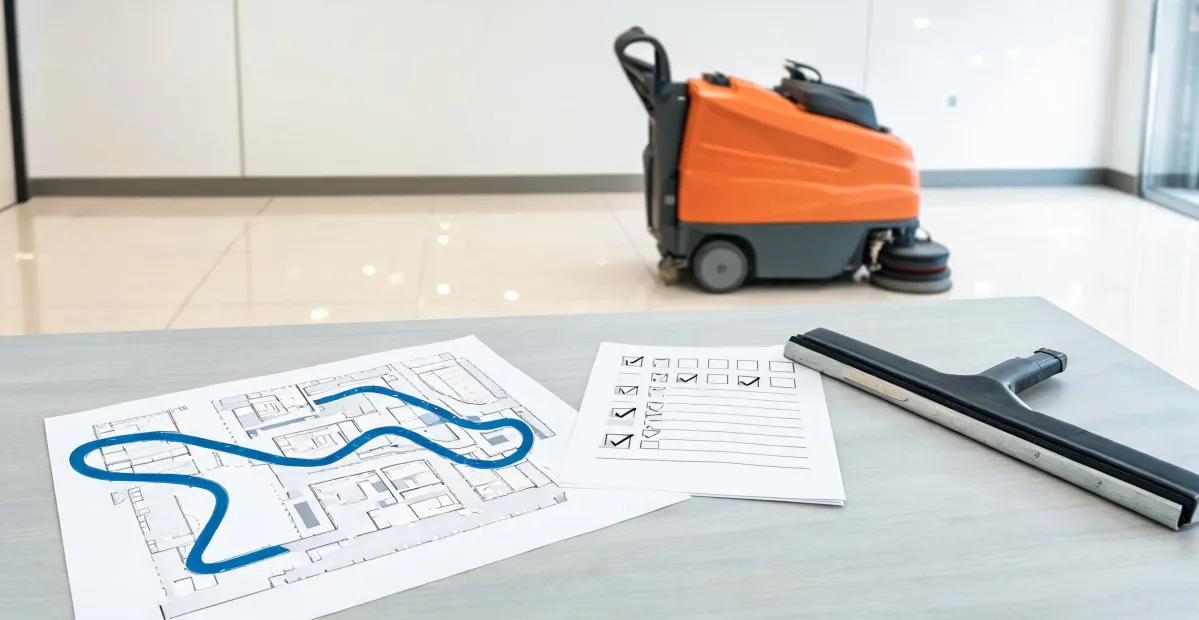
Before you rent a floor scrubber, here's the short answer: if you need a machine less than two days a month, rent it—but do not choose a rental provider by daily rate alone. The most expensive rental I've seen was a $180 'budget' machine that cost the contractor $2,400 in lost schedule time over one 8-hour day. I review 200+ machines a year as a quality and brand compliance manager, and I rejected roughly 6% of first deliveries in 2024 because of spec mismatches that a 15-minute pre-check would have caught. For most facility teams, the practical sweet spot is an automatic scrubber like the Clarke Kodiak 20—rented from a supplier that verifies the machine before it leaves the yard.
Here's the thing: 'renting floor scrubber' is a decision, not a category. The decision is about total cost of use, not the daily quote. That's the rule I apply to every piece of cleaning equipment that crosses my inspection table.
Why I trust this advice
I'm a quality and brand compliance manager at a commercial equipment company. In practice, that means I approve or reject every floor scrubber, sweeper, and pressure washer before it goes to a customer. In Q1 2024, I implemented a 15-point verification protocol for rental units after a machine went out with the wrong brush deck—and the customer didn't realize it until they'd lost a half day of cleaning. We've been catching about three issues per month since.
Over 4 years of doing this, I've learned one thing: most rental problems are not mechanical failures. They are specification gaps. The unit is technically a floor scrubber. It's just not the floor scrubber you asked for, or it's not in the condition you assumed.
The hidden cost of the lowest rate
Look, I'm not saying budget rates are always bad. I'm saying they're riskier. In my experience, the lowest quote has cost us more in about 60% of cases when we chased it. The extra cost usually appears in three places:
- Downtime. A worn battery pack can cut a Kodiak floor scrubber's runtime by 30%. You pay for the machine either way—and you also pay for your operator's idle time.
- Spec mismatches. 'Floor scrubber' is not a single product. A 20-inch walk-behind and a 32-inch rider are both floor scrubbers. One will do the job in half the time. The other is cheaper per day. That's not a bargain.
- Problem response. When a rental unit fails, who fixes it? If your rental provider has no local service, you're looking at days, not hours.
The most frustrating part of rental equipment is that the invoice looks the same whether the machine works or not. I once saw a contractor rent a pressure washer because they searched 'Sunbelt pressure washer rental' and got a great rate. The machine arrived with the wrong nozzle tip, and the unloader valve was leaking. It took three visits to get a working unit. Not ideal. The 'savings' disappeared in labor.
About Sunbelt pressure washer rental
Sunbelt is a real, established rental company, and sometimes their equipment is exactly right. This isn't an attack on them. But a rental rate quote—from Sunbelt or anyone else, including us—is not the same as a delivered, inspected, spec-verified working machine. If you're comparing options, ask three questions:
- What is the exact model, age, and condition of the unit I'll receive?
- Who prechecks it before loading, and what does that check cover?
- What happens if it's not running when I pick it up?
If you don't get clear answers, the daily rate is just an opening offer.
Why the Clarke Kodiak makes sense for most facilities
When I recommend a rental or purchase to facility managers, the Clarke Kodiak series comes up often. The Kodiak 20 is a battery-powered automatic scrubber with a 20-inch cleaning path, roughly 6,000 square feet per hour when in good condition, and a pickup system that handles both water and dry debris. It's not the cheapest machine in the market. It is predictable, and predictability is what I care about.
A commercial roofer in Lake Clarke Shores, Florida, told me a story about renting a floor scrubber for a post-construction cleanup. He went with a lower daily rate from a national chain. The machine showed up with a dead battery, and the chain didn't have a spare available for two days. He lost a weekend of labor. The next time, he rented a Clarke Kodiak from a local supplier, paid about 20% more per day, and finished the job in a single pass.
That's not a special story. It's the pattern I see with 'buy cheap, pay twice'—except in rental form.
What to check before you rent a Kodiak floor scrubber
During my Q1 2024 audit, I added these to the verification checklist for every Kodiak rental:
- Battery voltage and charge health, tested under load, not just with a meter.
- Brush deck alignment and pad condition. A worn pad leaves streaks and wastes time.
- Recovery tank seals. If the vacuum hose is cracked, you'll get more foam and less pickup.
- Documented runtime on a full charge, not the manufacturer's claim.
A good supplier will show you this in writing. A supplier that says 'it's fine, trust me' is a reason to hesitate.
The value-over-price calculus
Let's do the math simply. If you rent a floor scrubber for $200 per day, and it's two hours late, broken, or wrong, the actual cost is $200 plus the labor of two operators standing around. At $60 per hour each, that's $240 in idle labor—more than the daily rate. A rental at $250 per day that shows up on time and runs a full shift is the cheaper option, even before you count the schedule impact.
I know this isn't a revolutionary insight. Yet we keep renting the $200 machine because the $250 invoice is easier to compare than the $240 labor line that never shows up on the rental receipt.
When renting is the wrong call
Let me be honest about the boundary of this advice. If you're cleaning less than 2,000 square feet per week, you don't need a Kodiak floor scrubber at all. A quality mop and a microfiber pad will do the job better and cheaper. And if you're cleaning 10,000+ square feet every day, the math usually points toward buying—provided you have a service plan and a place to store it.
Renting makes the most sense for seasonal deep cleans, construction closeouts, and facilities that need equipment availability without a capital purchase. That's the sweet spot.
A note if you searched 'Clarke welder'
If you arrived here looking for a Clarke welder, check the label on your equipment. Clarke has different product lines in different regions; the welder line is separate from the commercial floor care equipment I inspect. It's an easy mix-up. I made the same mistake in my first year searching for a Clarke replacement part. This article is about the floor care side—but if you rent or own a Kodiak floor scrubber, these inspection rules still apply.
What I'd do next
If you're trying to decide on a rental, write down the actual date and shift hours you must cover. Call at least two suppliers and ask for the exact model, battery condition, and delivery time. If the supplier cannot answer those three questions, don't sign. That process has never failed me—except the time I followed my own advice but then skipped the final confirmation because 'we've worked with them for years.' It mattered that one time. The machine arrived with a 12-volt battery system instead of the 24-volt spec on the work order. $400 in extra labor, learned the hard way.
Rents vary by market and season. A typical automatic floor scrubber rental runs from roughly $175 to $350 per day, depending on width and battery condition (based on quotes from rental providers, February 2025; verify current rates).
That 'price as of' date is not a disclaimer—it's a habit. I verify everything else on the machine. I should verify pricing too.