-
1. Is a three-wheeled floor scrubber worth paying more for?
-
2. What's the actual difference between a sweeper and a scrubber?
-
3. Are floor scrubber attachments worth buying?
-
4. What should I pay for a warehouse floor sweeper?
-
5. Buy used, rent, or buy new?
-
6. What does maintenance really cost on a three-wheeled floor scrubber?
-
7. What's the most overrated upgrade on a floor scrubber?
-
8. What's the #1 mistake people make when buying floor cleaning equipment?
I manage procurement for a 340-person facilities company, with an annual equipment budget of about $180,000 across 9 sites. We run a fleet of 12 Clarke machines, and I've tracked every invoice, repair, and rental agreement for the past 6 years. If you have questions about floor scrubbers or sweepers, I've probably priced it, rented it, fixed it, or bought it.
Quick search-intent note: if you're here for the Alembic Stanley Clarke signature bass price or land for sale in Clarke County, Alabama — not this page. This is about Clarke the floor care equipment brand. If that's what you're after, the questions below are the ones I actually get asked in procurement meetings.
1. Is a three-wheeled floor scrubber worth paying more for?
It depends on your aisles, honestly. If you're working with aisles narrower than about 5 feet, a three-wheeled configuration is almost a no-brainer. The tighter turning radius means you're not doing six-point turns around racking every shift. Clarke's three-wheeled floor scrubbers turn in roughly 60 inches. That matters when you're threading between pallet racking.
The price premium for three-wheeled vs. comparable four-wheeled machines usually runs 10-15%. Whether it pays off comes down to your floor layout. In confined warehouses, I'd estimate a three-wheeled machine saves 20-30 minutes per shift. That works out to about 120 hours a year. At $18/hour loaded labor cost, that's $2,160. The premium pays for itself by around month 18.
For wide-open floors like aircraft hangars or big-box distribution centers, a four-wheeled model is probably the smarter call. Don't let a salesperson talk you into a three-wheeled machine if your floor is essentially one big rectangle.
2. What's the actual difference between a sweeper and a scrubber?
I get this question more than any other, and getting it wrong is expensive.
A sweeper picks up dry debris — wood chips, gravel, pallet wrap, dirt dragged in from the yard. A scrubber uses water, cleaning solution, and a brush or pad to remove contaminants from the floor surface itself — oil, tire marks, sticky residue. Different tools, different problems.
The "you only need one machine" thinking comes from an era when warehouses were smaller and floor conditions were simpler. That's changed. Most operations with forklift traffic need both capabilities — which is why Clarke builds both sweepers and scrubbers across their lineup. It's not a sales pitch. It's the reality of mixed floor conditions.
In Q2 2024, a site manager at one of our properties was sweeping with a scrubber and scrubbing with a sweeper because nobody'd checked the spec sheets. The scrubber kept clogging on wood debris. The sweeper couldn't touch the oil stains. Two equipment corrections later — and $1,400 in extra rental and labor costs — they had the right tools. Read the spec sheet before you buy. It takes 15 minutes and saves the kind of money that makes budgets look bad.
3. Are floor scrubber attachments worth buying?
Attachments exist, but the word "attachment" gets used loosely in this industry. There's a difference between swappable components for the same base unit — like interchangeable brush sizes or a dust mop kit — and full conversion kits that try to turn one type of machine into another.
Swappable components are generally a good investment. A different brush width or a squeegee upgrade for our Clarke units cost $200-600 each, and they genuinely change what a machine can handle in tight or open areas.
Full conversion kits are another story. These often run $2,000-4,000, and they only work on certain machine platforms. I've seen buyers spend $3,500 on a convertible floor scrubber attachment kit that turned out incompatible with their machine's brush deck. That's the "saved $200 on research, spent $3,500 on the wrong part" trap.
My advice: call the manufacturer with your serial number and ask for the accessory compatibility guide first. Cost of the call: $0. Cost of the wrong attachment: a lot more than the phone call.
4. What should I pay for a warehouse floor sweeper?
If you've been searching "warehouse floor sweeper for sale" — and plenty of facility managers in Beloit and across the Midwest have had that exact search open — here's a realistic price picture as of Q4 2024. Pricing varies by market, so verify current rates:
- New walk-behind sweepers from major brands: $6,000-15,000
- Used walk-behind sweepers in decent shape: $3,000-7,000
- New ride-on sweepers: $18,000-35,000
- Used ride-on sweepers, 3-5 years old: $8,000-18,000
My experience here is based on roughly 200 equipment and parts orders over six years, mostly in Midwest warehouses. If you're running a food processing facility or a hospital, your specs — and your costs — will differ.
If you see a warehouse floor sweeper for sale well below those ranges, be suspicious. I've seen "great deals" on former rental units with 4,000+ hours on them. The purchase price looked 40% below market. The first-year maintenance ate every dollar of savings.
In 2023, I audited our sweeper spending and found one of our best "deals" had cost us $1,150 in new brooms, filters, and labor within the first six months. The savings over buying a better-condition unit: about $600. That's the bad math of bargain hunting.
5. Buy used, rent, or buy new?
I've now done all three, and here's the rule of thumb I've landed on:
- If you need a machine for under 12 months — rent. We rented a scrubber for a temporary site in 2024 at $650/month. The alternative was a $28,000 purchase. Rental was obviously the right call.
- If you need a machine daily for 3+ years — buy new or nearly new. A quality unit with proper maintenance will run 5-7 years. The per-year cost beats rental from year two onward.
- The 12-36 month zone is where I get cautious. A used machine with a clear service history can make sense. A used machine from a liquidation auction with no records is a gamble. No service history, no deal. That is not a slogan — it's a rule.
One thing that surprised me favorably about Clarke in the last couple years: their catalog includes pre-owned machines and rental options, not just brand-new sales. Most manufacturers in this space only want the upfront sale. A company that supports all three paths is thinking about your total cost of ownership, whether they call it that or not.
6. What does maintenance really cost on a three-wheeled floor scrubber?
Honestly? More than the salesperson quotes you — unless you're disciplined about preventive maintenance. I've tracked six years of invoices on our Clarke units. Here's my budgeting guidance. Don't hold me to these exact numbers — battery and brush pricing shifts with type and floor conditions — but this is the right ballpark for planning purposes:
- Battery replacement: $2,500-4,000 every 3-4 years, depending on battery type and charging habits
- Brushes: $150-400 per set, every 6-18 months depending on floor abrasiveness
- Squeegee blades: $80-200 per set — replace these annually at minimum. A worn blade leaves streaks, and streaked floors get re-run, which doubles the labor cost per pass
- Preventive service visits: $300-500 per year per machine if you don't have in-house maintenance staff
My genuine mistake in this area came in early 2022, when I tried to extend squeegee blade life on four machines by three months. I saved maybe $350 in parts. I paid roughly $900 in extra operator labor from streaky passes — and that's a conservative estimate. The "preventive" part of preventive maintenance is not just about machine health. It's about not doing every job twice.
7. What's the most overrated upgrade on a floor scrubber?
I might get pushback for this, but it's the auto-fill and auto-dump option package on ride-on machines. The convenience features are genuinely nice — I've seen the demos. But that system failed on one of our units in year two. Sensor replacement: $600. The manual drain valve on our older unit? Never failed once in six years.
That's not to say you should never buy the upgrade. Math matters: if the option adds $3,000 to the machine price but saves roughly 10 minutes per shift in operator time, that's about $2,340 a year in labor at $18/hour. It pays for itself in about 16 months. I do not think the feature is worthless. Just check the warranty coverage on the automated systems specifically — those components are the ones that fail, not the manual valves.
What I actually think is overrated? The high-capacity battery upsell on smaller machines. I've seen buyers spend $1,500 extra on battery capacity they'll never use because their shifts are 4 hours, not 12. I've been that buyer — in 2021. I don't make that mistake anymore. Put that $1,500 toward a spare set of brushes and a service visit instead.
8. What's the #1 mistake people make when buying floor cleaning equipment?
Buying without measuring. That means both the floor plan and the actual cleaning needs. I've seen a warehouse manager buy a ride-on sweeper that couldn't fit through the equipment room door. I've seen a facility buy a 24-inch scrubber when the shift schedule required a 36-inch machine. The cost of those mistakes — return fees, re-dos, schedule delays — is entirely avoidable. Facilities that follow ISSA's CIMS guidelines document their equipment selection process for exactly this reason (Source: ISSA, Cleaning Industry Management Standard). You don't need the certification to benefit from the habit.
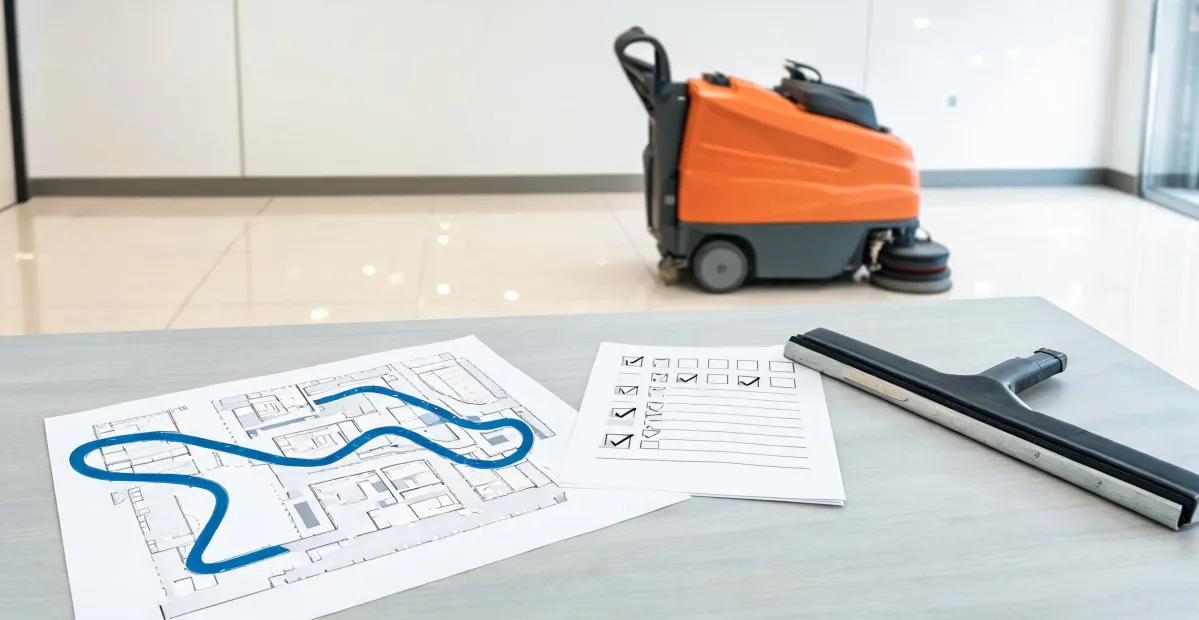
Here's the checklist I use, and I recommend it to anyone who'll listen:
- Measure every narrow aisle, door frame, and elevator threshold. Write it down.
- Time a current cleaning shift, then double it — that's your realistic baseline.
- Compare the spec-sheet path width and turning radius to your measurements.
- Verify attachment compatibility before you buy, not after.
- Demand service history on used machines. If the seller won't share it, walk away.
- Calculate total cost of ownership over 5 years — maintenance, energy, operator labor, downtime.
That checklist took me 30 minutes to put together and has saved me an estimated $38,000 in avoided mistakes over four years. The 5 minutes you spend measuring a doorway costs less than the $400 return shipping fee on a machine that doesn't fit. Five minutes of verification beats five days of correction. I've never seen that sentence fail.