-
1. What's the #1 mistake people make ordering Clarke floor scrubber parts?
-
2. Is the Vevor floor sweeper a good budget alternative?
-
3. Should I repair my T7AMR floor scrubber or replace it?
-
4. Are robotic scrubbers like the Scrubber50 Pro worth it?
-
5. How do I know if a Clarke part will fit my machine?
-
6. What's the most overlooked part on a commercial floor scrubber?
-
7. How do I train my team so they stop breaking equipment?
If you manage a commercial floor scrubber, you've probably either ordered the wrong part or watched a brand-new one fail early. I've done both. In 9 years of handling maintenance and parts orders for commercial cleaning equipment, I've personally made 14 significant ordering mistakes—totaling roughly $12,000 in wasted budget. Now I maintain our team's checklist to prevent others from repeating my errors. Here's what I wish someone had told me from day one.
In this guide:
- The #1 mistake people make ordering Clarke floor scrubber parts
- Is the Vevor floor sweeper a good budget option?
- Should you repair a T7AMR floor scrubber or replace it?
- Are robotic scrubbers like the Scrubber50 Pro worth it?
- How to know if a Clarke part fits your machine
- The most overlooked part on a commercial floor scrubber
- Training your team to stop breaking equipment
1. What's the #1 mistake people make ordering Clarke floor scrubber parts?
They order by the machine name instead of the serial number and part number. I did this in my first year (2018). I searched for "Clarke floor scrubber parts" and found a squeegee assembly that looked exactly like what I needed. $320 later, it didn't fit the mounting bracket. Turns out Clarke has used the same model name across multiple generations while changing the parts between them. The name on the machine isn't enough to identify the right part.
The part itself cost $320, but the real hit was two days of downtime while we waited for the correct one. In a facility that runs shifts around the clock, downtime is the expense no one tracks on the invoice.
Before you buy anything, find the serial plate, write down the model number and serial number, and confirm the part number against the parts diagram. If the supplier's website doesn't support that, talk to a human. 5 minutes of verification beats 5 days of downtime every time.
2. Is the Vevor floor sweeper a good budget alternative?
I get asked about the Vevor floor sweeper a lot, especially by facility managers who are tired of high parts bills. Honest answer: Vevor machines are cheaper up front. No question. For light-duty spaces and occasional use, they're fine as a backup. I've seen one hold up reasonably well in a small retail store.
But here's what I learned the hard way: total cost of ownership matters more than the sticker price. When a Vevor breaks down, parts often mean waiting on overseas shipping, and the repair cost can eat up the money you saved on the purchase. Before you buy any budget machine, check the parts situation first. Look up how long common wear items take to arrive. If the answer is "we don't stock those," you're not buying a machine—you're buying a future repair headache.
I keep a Vevor for small overflow areas, but for daily heavy traffic, a full commercial unit with reliable parts supply is still the no-brainer.
3. Should I repair my T7AMR floor scrubber or replace it?
The T7AMR floor scrubber has a long service life if it's been maintained well. But eventually the math changes. My rule of thumb: if the repair estimate is more than half the cost of a replacement, and the machine is more than 7 years old, it's usually time to replace.
I watched a colleague ignore that math in January 2024. He spent $1,400 repairing his T7AMR, and three months later the motor went. He ended up buying a new machine anyway—that $1,400 was gone. My checklist for this decision: (1) what does the repair actually cost in parts and labor, (2) how many hours are on the machine, (3) how many times has it been down in the last 12 months? If you're calling a repair tech every few months, that's not bad luck—it's a pattern, and that pattern costs more than a new machine.
4. Are robotic scrubbers like the Scrubber50 Pro worth it?
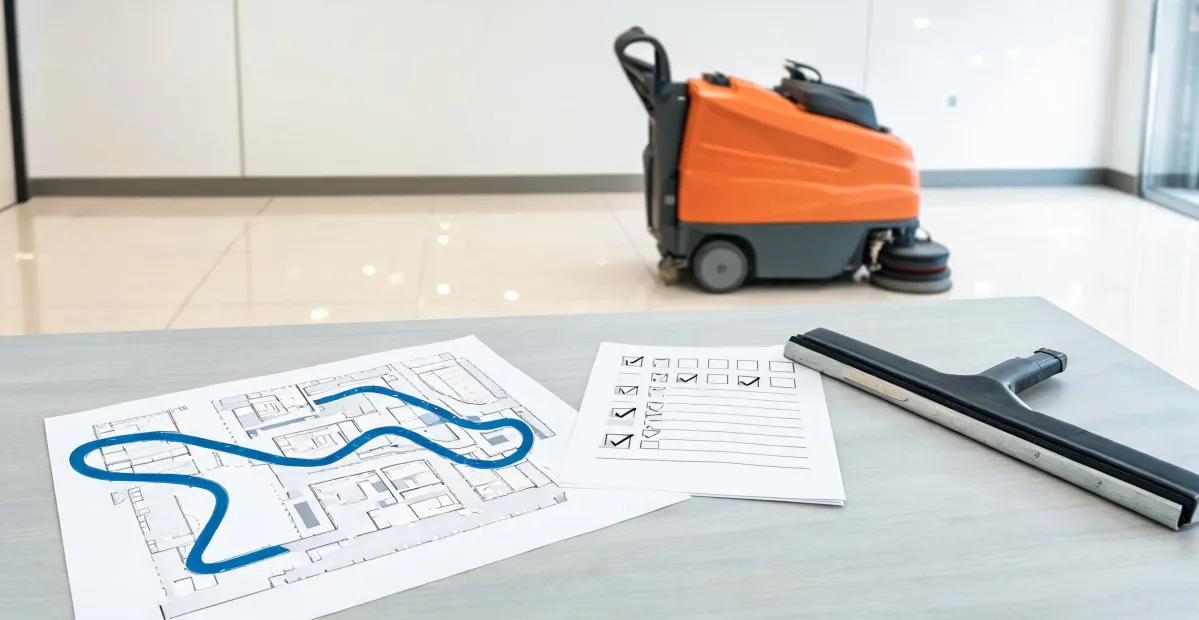
I was skeptical when the Scrubber50 Pro robotic floor scrubber first showed up in our industry. I assumed it was a gadget—something that would get demoed once and then collect dust in a corner. Then I watched one work a 30,000 sq ft warehouse floor on a tight route. It did the job without a break, and the floor looked consistent afterward.
But there's a nuance: a robotic scrubber pays for itself only in the right environment. Open floor plans, predictable routes, minimal obstacles—that's the sweet spot. I've also seen teams buy one and then underuse it because nobody set up the route properly. That's not the machine's fault, but it becomes the buyer's problem. If your facility has constantly changing layouts, or your team won't invest time in setting up cleaning maps, you're not buying a labor saver, you're buying an expensive software problem. Match the technology to the reality of your floor, and make sure your team is on board before you sign anything.
5. How do I know if a Clarke part will fit my machine?
This is where I've burned the most money, so listen close. "It looked right" is not a specification. I once ordered 12 squeegee blades because the photo matched what was on our machine. They didn't fit. When I called the supplier, they asked for the serial number, and I didn't have it. I told them to just send the ones in the photo. That's when I realized we'd been saying the same words but meaning different things. They heard "universal part"; I meant "compatible with my specific Clarke model." Result: 12 wrong blades, roughly $450 wasted, and a 1-week delay.
Now every parts order starts the same way: I pull the serial plate, snap a photo, and send it to the supplier if there's any doubt. If a supplier doesn't ask for the serial number, I treat that as a red flag. A good supplier wants to prevent returns just as much as you want to prevent downtime.
6. What's the most overlooked part on a commercial floor scrubber?
Squeegee blades. Everyone obsesses over scrubber pads, and pads matter. But a cracked or worn squeegee blade makes your machine leave streaks no matter how clean the pad is. A replacement blade costs about $60 and takes 10 minutes to install. Yet I still see machines running with blades well past their useful life, leaving a trail of water and soap that makes the whole job look bad.
The same "small part, big impact" logic applies to vacuum motors and hose connections. And if you're running a dust collector, check the filter gasket. It's a $20 part, and when it fails, your dust collection efficiency drops fast without any obvious warning. One gasket failure cost us $890 in redo work because we didn't catch it until dust was already settling on surfaces we'd just cleaned. I've caught 47 potential failures over the past 18 months just by checking these small parts on a schedule.
7. How do I train my team so they stop breaking equipment?
I used to think breakdowns were just the cost of doing business. Then I attended a facility maintenance workshop where Richard D. Clarke was a speaker. He made a point that stuck with me: most equipment failures are training failures rather than part failures. I didn't want to agree. I preferred to blame parts, because parts failures are easy to point at. But when I pulled our work orders, the pattern was obvious—the same operators were making the same small mistakes over and over.
So I built a simple 12-point checklist. It's the boring kind you do while your coffee is brewing: check the water level, check the squeegee blade, listen to the vacuum motor, wipe down the dirty filter. In the 18 months since we started, we've caught 47 potential errors before they turned into expensive failures. The daily cost is about 15 minutes of staff time. The savings have been in the thousands.
If you get a chance to hear Richard D. Clarke speak at an industry event, take it. If not, start with a checklist. I learned this lesson the expensive way so you don't have to: prevention is always cheaper than the repair.