When I took over facility purchasing in 2020 for a 400-person company with three locations, the first thing I learned is that there’s no such thing as a “best” big floor scrubber. What works for a 50,000 sq. ft. warehouse with smooth concrete won’t work for a hospital with tile transitions and tight corners. And what fits a tight budget today might cost you triple in downtime next year.
I manage roughly $80,000 annually across 8 vendors for cleaning equipment, parts, and service. I’ve ordered everything from walk-behind scrubbers to ride-on sweepers. And I’ve definitely made my share of mistakes—like the time I skipped verifying a vendor’s service network because “it’s basically the same as last time.” It wasn’t. A $400 rush repair later, I learned my lesson.
This guide breaks down three common facility scenarios and the specific factors that should drive your choice of a large floor scrubber. I’ll share data points from actual purchases, the hidden costs I didn’t expect, and the questions I now ask before signing any PO.
Why Size and Capacity Aren’t Everything
The first trap is assuming bigger is better. A larger scrubber covers more square footage per hour, but it also costs more to buy, costs more to maintain, and it’s harder to maneuver. For a facility with narrow aisles or multiple zones, a mid-sized unit can actually be more productive because you’re not wasting time turning or repositioning.
Key metrics I now track:
- Productivity rating: Square feet cleaned per hour in ideal conditions (open floor, no obstacles).
- Effective coverage: Real-world square footage accounting for turns, obstacles, and downtime.
- Total cost per hour: (Purchase price + annual maintenance + energy/water costs) ÷ estimated operating hours over 3 years.
In my experience managing over 60 orders annually, the model with the highest productivity rating often costs 20–30% more in total operating cost per hour compared to a moderately sized unit that matches your actual facility layout.
The Three Scenarios for Choosing a Big Floor Scrubber
I’ve categorized every facility I’ve worked with into one of three scenarios. Your situation might blend elements of two, but one will dominate.
Scenario 1: You Have a Single, Large Open Space
Typical facilities: Warehouse floors, distribution centers, manufacturing plants with unobstructed layouts.
Your priority: Maximum hourly coverage. You want as much scrubbed as quickly as possible.
For this scenario, a ride-on scrubber with a 36–40 inch scrubbing path is ideal. The Clarke CS16, for example, has a 36-inch path and can cover roughly 60,000 sq. ft. per hour in clean conditions. I’ve seen it work well in a 100,000 sq. ft. warehouse where the only obstacles are pallet racking corners.
What I learned the hard way: I ordered a larger ride-on unit (44-inch path) thinking it would double our productivity. The turning radius was too wide for the aisle width. We spent more time backing up and repositioning than actually scrubbing. The effective coverage was about the same as the 36-inch model, but the purchase price was 40% higher.
My recommendation: Measure your aisle widths and turning spaces before deciding on deck size. A 36-inch model often works better in multi-aisle warehouses than a 44-inch model. Also factor in charging time—larger batteries mean longer charging cycles. If you run two shifts, a smaller unit with hot-swappable batteries might be more efficient.
Scenario 2: You Have Mixed Surfaces and Multiple Zones
Typical facilities: Schools, hospitals, retail stores, office buildings with tile, vinyl, carpet edges, and entry mats.
Your priority: Versatility. You need a machine that can handle different surfaces without damaging transitions or leaving streaks.
This is where you want a walk-behind or stand-on scrubber with adjustable brush pressure and solution flow. A machine like the Clarke CS16 (or similar mid-size walk-behind) gives you control over scrubbing aggressiveness without the weight of a ride-on unit.
A mistake I made: We bought a ride-on scrubber for a school facility because the square footage looked big on paper. The problem: 30% of the area was carpeted hallway with tile entryways, plus small classroom zones under 300 sq. ft. The ride-on was too big to turn in classrooms, and it left marks on the vinyl transitions between tile and carpet. We ended up using a small walk-behind for 70% of the tasks. The ride-on sat idle most of the time. That $5,000 investment wasn’t wasted, but it taught me to match the machine to the actual cleaning pattern, not just the total square footage.
My recommendation: Look for a scrubber with adjustable brush pressure (at least two settings) and a solution shut-off for dry passes. If you need to clean wet areas (kitchens, restrooms), make sure the machine has good drainage and easy-to-clean tanks. Also consider noise levels—a loud ride-on in a hospital corridor is a non-starter.
Scenario 3: You’re Managing a Large, Complex Facility with Multiple Teams
Typical facilities: Large campuses, multi-story buildings, facilities with multiple cleaning crews across shifts.
Your priority: Consistency, reliability, and service support. You need a machine that every operator can use without extensive training, and that your service vendor can repair quickly.
Here, brand matters. Clarke equipment has a strong reputation for durability and parts availability. The CS16 floor scrubber, for instance, uses common components that many service techs know how to fix. When I’ve had to source parts for a broken down scrubber in a multi-team facility, parts availability is the difference between a 2-hour repair and a 2-day wait.
A process gap I fixed: We didn’t have a formal equipment check-out process for shift changes. The third time a machine went down because the previous shift had emptied the dirty water tank but hadn’t refilled the fresh water or charged the battery, I created a simple checklist. It took 10 minutes to make and saved us at least $600 in repair calls over six months. The point: even a good machine fails if the process around it is weak.
My recommendation: Look for a scrubber with easy access to filters, brushes, and solution lines. If you run multiple shifts, consider a model with quick-change battery packs or a fast charger (2-hour charge time). Also, verify that your service vendor stocks parts for the specific model you’re buying. I ask “what’s the typical repair time for this machine?” If it’s over 48 hours, I reconsider.
How to Determine Which Scenario You Belong To
Here’s the checklist I now use before any floor scrubber purchase:
- Measure the open space: What’s the largest continuous area (no doors, no columns, no turns) that needs cleaning? If it’s under 10,000 sq. ft., Scenario 2 likely applies. Over 50,000 sq. ft. with few obstacles? Scenario 1.
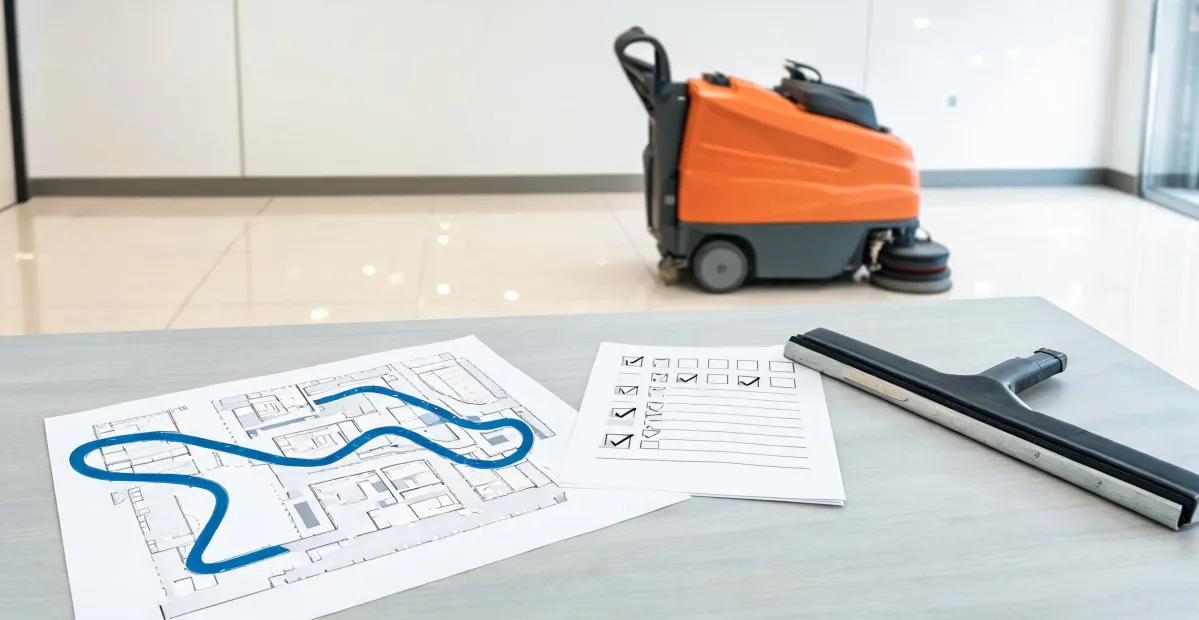
- Map the obstacles: Walk the route your cleaning team will take. Count tight turns, doorway widths, and surface changes. If you encounter more than 3 surface types or turns tighter than 90 degrees, lean toward Scenario 2.
- Assess your team and schedule: Do you have a single cleaning crew or multiple shifts? If multiple, Scenario 3 factors become critical. If single-shift, you can optimize more for cost per hour.
- Check service availability: Call 3 local service vendors. Ask if they stock parts for the model you’re considering. If none of them do, you’re in Scenario 3 territory and need to prioritize service support over price.
For example, a 60,000 sq. ft. warehouse with smooth concrete and wide aisles is clearly Scenario 1. A 30,000 sq. ft. school with tile hallways, carpeted classrooms, and vinyl restroom floors is squarely Scenario 2. And a 100,000 sq. ft. hospital with multiple wings, a dedicated janitorial team, and a 3-shift cleaning schedule is Scenario 3, even though it has some open areas.
One more thing: Don’t overlook the value of a good supplier relationship. In my experience, the lowest quoted price has cost us more in 60% of cases. That $200 savings on a cheap scrubber turned into a $1,500 problem when the machine broke down twice in the first year. I’d rather pay a fair price for a reliable machine from a vendor who supports it than chase a bargain that ends up costing triple in downtime.
If you’re evaluating a Clarke CS16 or any similar big floor scrubber, start with your scenario. The right choice for your facility depends on your specific layout, team size, and service needs. There’s no one-size-fits-all—but there is a right size for your situation.