Every month, someone lands on our equipment site searching for 'Jamie Clarke speaker.' This is not that. But if you're looking for Clarke floor scrubber parts, or you're trying to decide between a Clarke floor scrubber and a Zamboni floor sweeper, you're in the right place.
I've been handling equipment orders for 8 years. I've personally made (and documented) 31 significant mistakes, totaling roughly $46,000 in wasted budget. Maybe 180 orders—I'd have to check the system. Now I maintain our team's checklist so the next person doesn't repeat my errors.
This article is the comparison I wish I'd read before my third year in this role. It covers what each machine actually does, what ownership really costs, and why I now pay more for delivery dates I can trust.
The Comparison Framework
The first mistake I made was treating a floor sweeper and a floor scrubber as if they were the same category. A Zamboni floor sweeper is designed for dry debris—dust, dirt, parking lot grit. A Clarke floor scrubber is designed for wet cleaning: it lays down solution, scrubs with a pad, and picks the liquid back up.
Put another way: one is a motorized broom, the other is a power mop. In the current floor scrubber market, combo machines blur that line, but the core question is still what's on your floor and what you need gone. I learned this in 2017 when I bought a sweeper to solve a sticky residue problem in a food production area. It pushed the sticky film around. It looked cleaner, but it wasn't. That mistake cost us about $2,300 in labor and a re-scrub before the next health inspection.
What Are You Actually Cleaning?
If your problem is dust, dry dirt, or metal shavings, a Zamboni floor sweeper is the right tool. Those machines cover ground fast and don't require water recovery. If your problem is grease, spills, or a dull film on sealed concrete, you need a scrubber. A Clarke walk-behind scrubber with the right pad can handle that, but it only works if the pad is actually touching the floor. Check pad pressure (the downforce on the cleaning head) before you assume a machine is defective. I've watched two techs 'fix' a scrubber that just had the pressure set too light.
If your facility has both types of soil, you may need both machines. But if you're starting with one, I'd start with the scrubber when the facility is sealed concrete. Sweepers are great for large dust loads, but they don't remove the oily film that makes a floor look dirty.
The comparison conclusion: sweeper and scrubber are different tools, not competing brands. Choosing between them based on brand name is how I wasted $2,300.
What Does It Really Cost?
If you're comparing a used Zamboni floor sweeper to a new Clarke floor scrubber, the sweepers often look cheaper. That can be true on paper. But total cost of ownership (i.e., not just the unit price but all associated costs) is a different story.
The floor scrubber market has shifted toward battery-powered walk-behinds, so older corded scrubbers are easier to find at lower prices. That's an opportunity, but it's a trap if the batteries are near the end of their life. I've seen battery pack replacements run from $1,800 to $3,500 depending on the model. If a dealer can't show you the battery test results, assume the worst.
Another trap is maintenance history. A used machine with a clean exterior can still have worn brushes, tired bearings, or a corroded charger. I weighed this exact decision in September 2022. The upside was $8,000 in savings on a pre-owned unit. The risk was downtime if it failed in the first month. I kept asking myself: is $8,000 worth potentially losing a client? In hindsight, the answer was no. I didn't listen to myself, and the unit needed a brush motor replacement 5 weeks later. The repair plus lost rental income ate most of the savings.
New equipment also has a warranty that's worth something. When I bought a new Clarke scrubber in 2023, the dealer included a 90-day labor warranty. Three months later, a hose fitting failed. The replacement was free, and the repair took one visit. On a used machine, that same failure would have been a $350 invoice plus two days of calls.
Even after choosing the pre-owned unit, I kept second-guessing. What if the brush motor dies again? The first three months were stressful. I didn't relax until it passed its 500-hour mark.
What Happens When It Breaks?
If you searched 'Clarke floor scrubber parts' before reading this, you already know the real value of a machine is how fast you can get it running again.
Clarke has broad parts availability. That's a strong reason to choose a Clarke scrubber if you don't have an in-house mechanic. In my experience, Clarke floor scrubber parts are easier to find than Zamboni sweeper parts because Clarke's dealer network is built around commercial cleaning. But that advantage disappears if the dealer is far away or doesn't stock what you need.
For consumables like scrubber pads and squeegees, I try to keep a small stock. That means checking part numbers before you run out, not after. The cost of a part is small; the cost of an unplanned stop is not.
I once ordered 12 scrubber pads with the wrong diameter. Checked it myself, approved it, processed it. We caught the error when the pallet arrived. $890 wasted, plus a 1-week delay, plus my own embarrassment. Now the pad driver size is the second line on my order template.
If you're buying a used Zamboni floor sweeper, ask for the parts list: brushes, filters, belts, bearings. Then confirm those parts are actually available. In September 2022, I bought a 'refurbished' sweeper and discovered the brush deck wasn't included. The dealer said 'remanufactured.' What I mean is they'd replaced the engine, but not the deck. It took 6 weeks to get the deck. During those 6 weeks, we still had dirty floors.
Can You Get It On Time?
Some purchases are planned. Others happen because a client has a grand opening, an audit, or a project deadline. In those cases, delivery date matters more than price.
In March 2024, we paid $400 extra for rush delivery on a Clarke part. The alternative was missing a $15,000 event. I still think that $400 was the best money we spent that quarter. What we were buying wasn't speed. We were buying certainty—the guarantee that the part shows up when it's supposed to show up.
In the current floor scrubber market, lead times for new machines have improved since 2022 but still vary by model. Some popular models are stocked by regional dealers; others are built to order. If the model you want isn't available, ask for the closest available model or a rental bridge.
Renting is another way to buy certainty. I used to see rental costs as wasted money. Now I see them as a hedge: if your deadline is locked, a rental bridge can keep the job moving while a new unit is in transit. It's not a long-term solution, but it's a real option when 'probably by Friday' isn't good enough.
If you're searching for a new floor scrubber in Jackson, MS, this is the question to ask every dealer: 'Is it in stock, and what is the guaranteed delivery date?' Not 'when do you think it will ship?' Not 'probably by the end of the week.' A dealer who won't put a delivery date in writing is a risk, no matter how low the quote is.
In an emergency, 'probably on time' is the most expensive phrase in facilities management.
This isn't about panic-buying the first available machine. It's about quantifying the cost of being late. If a one-day delay costs you $2,000 in overtime, paying $400 for guaranteed delivery is a bargain.
What I'd Do Differently
If you're trying to decide between a Clarke floor scrubber and a Zamboni floor sweeper, start with the floor, not the brand. What's the soil? Is it dry or wet? Is the surface sealed concrete, tile, or asphalt? Once you answer that, half the decision is already made.
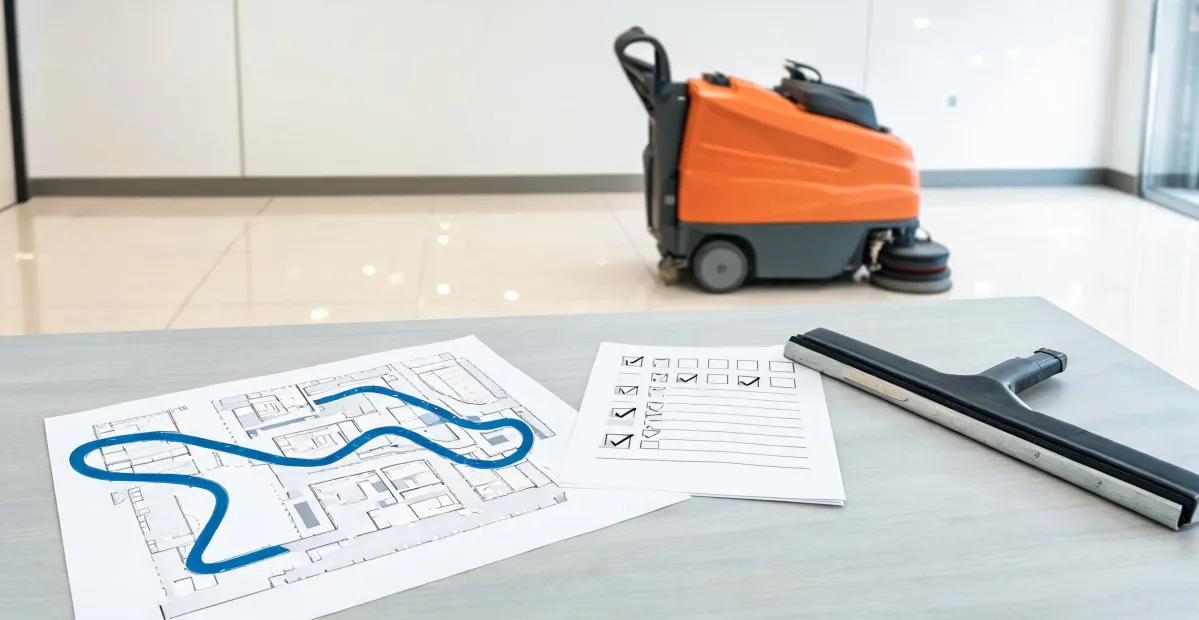
If you're in the market for a new floor scrubber in Jackson, MS, find a dealer that does demos. A 30-minute demo on your own floor tells you more than a spec sheet. Then run this checklist before you sign:
- Match the machine to the soil type, not the marketing photos.
- Get a written quote that includes batteries, charger, pads, and startup training.
- Verify backup parts availability before you sign.
- Insist on a guaranteed delivery date if your deadline matters.
This was accurate as of Q4 2024. The floor scrubber market changes fast, so verify current pricing and lead times before you budget. I don't have a perfect record, and I won't pretend otherwise.
But the checklist above has caught 47 potential errors in the past 18 months. If it catches one for you, that's one less mistake than I made.